
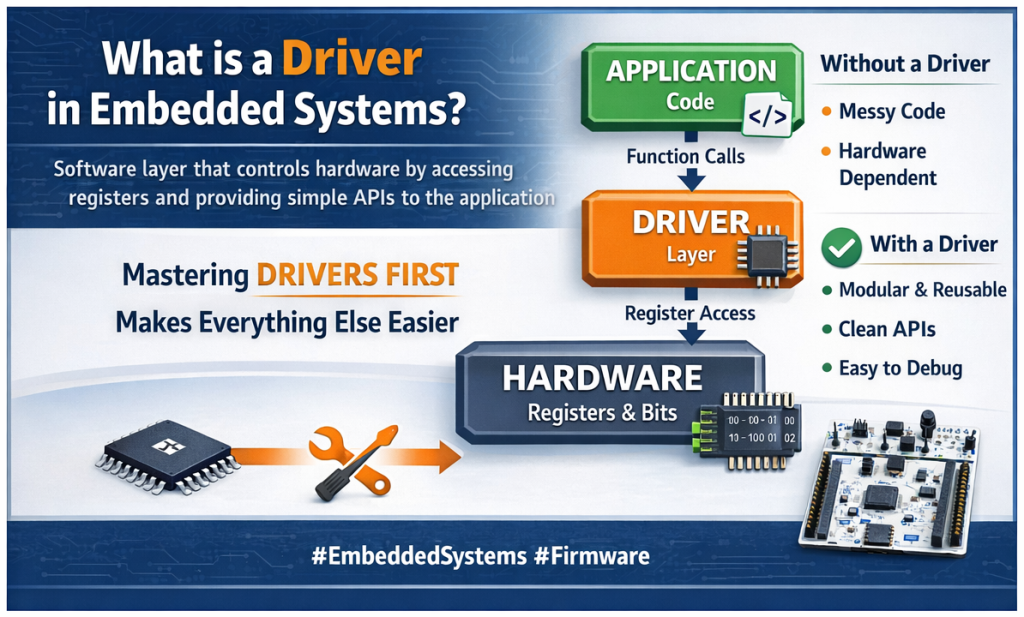
What is a Driver in Embedded Systems?
Many beginners jump straight into writing code, but miss a fundamental concept: the driver.
In embedded systems, a driver is the software layer that directly controls hardware by configuring and accessing memory-mapped registers. It understands how the peripheral works internally and exposes simple, safe APIs to the application layer.
In simple terms:
Hardware speaks registers and bits
Applications speak functions
The driver is the translator
Without drivers, application code becomes messy, hardware-dependent, and hard to maintain.
With proper drivers, code becomes:
Modular
Reusable
Debuggable
Industry-ready
This is why professional firmware development always follows a layered approach:
Application → Driver → Hardware
Currently working on writing my first register-level driver on STM32F446RE, starting with GPIO. Strong fundamentals here make every advanced topic easier later.
If you are learning embedded systems:
👉 Don’t rush peripherals.
👉 Master drivers first.
hashtag#EmbeddedSystems hashtag#FirmwareDevelopment hashtag#STM32 hashtag#Drivers hashtag#BareMetal hashtag#LearningByBuilding hashtag#ElectronicsEngineering